

API Access
Blueticks provides a simple REST API that allows you to send WhatsApp messages programmatically using your personal WhatsApp account through our browser extension.
Getting Started
To access the API:
- Navigate to your Account Settings
- Select “API” from the sidebar (or go directly to app.blueticks.co/blueticks-api)
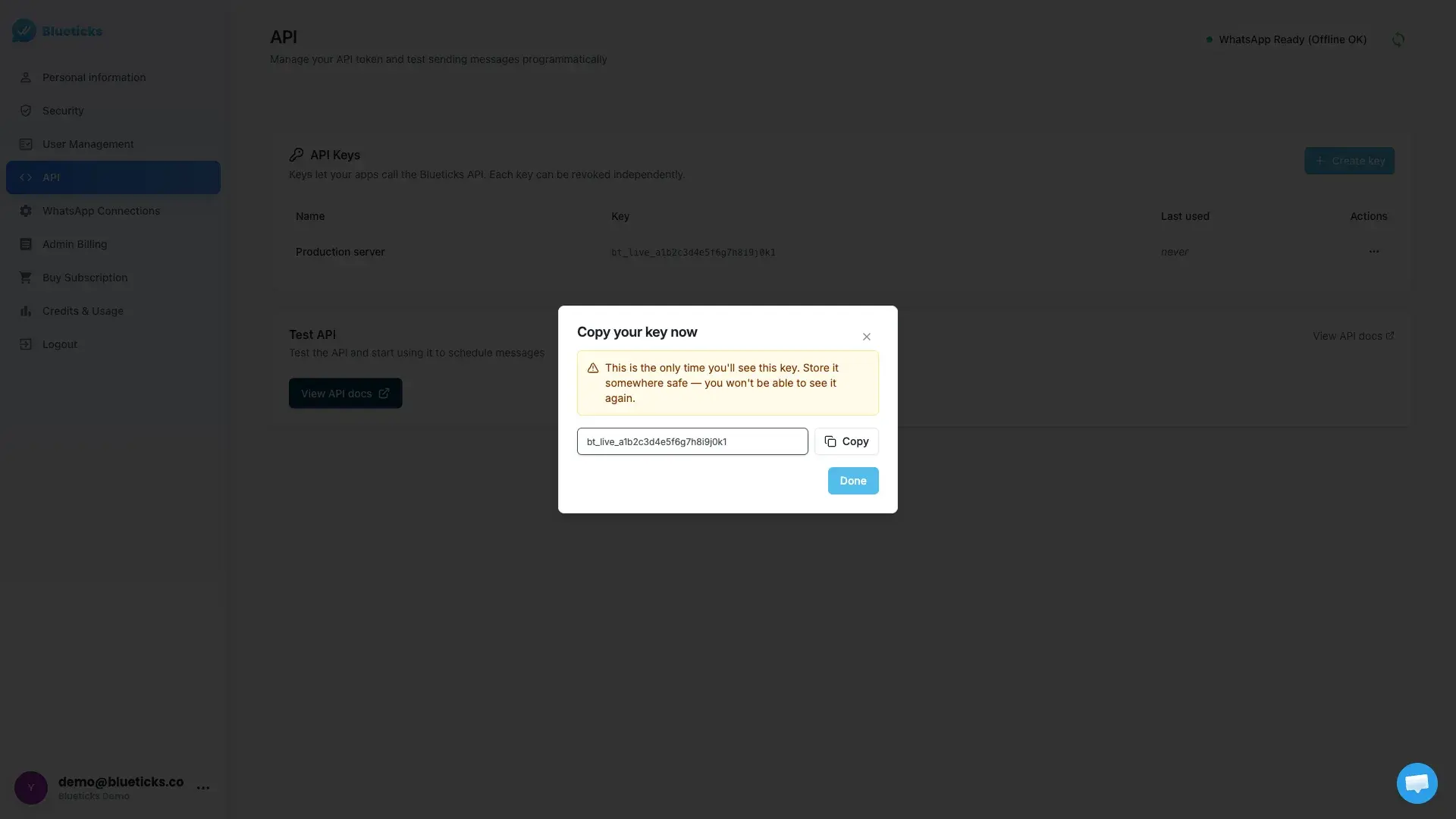
- In the API Keys section, click Create, give the key a name (e.g. “production”), and it will appear in your keys list — copy it from there
API Authentication
The Blueticks API uses API key authentication. You create one or more named API keys on the API page and send a key as a Bearer token on every request.
Your API Keys
- Each workspace can have multiple named API keys — create a separate key per integration so you can rotate or revoke them independently
- Click Create to add a new key and name it, then copy it from the keys table using the copy icon next to it (copy it right away and store it securely)
- Send it on every request in the
Authorizationheader:Authorization: Bearer <your-key>— keys look likebt_live_... - Delete a key from the table at any time to revoke it (this immediately invalidates that key)
- Keep your API keys secret and never share them publicly
Note: the read-only “Your API token” box in the Test API section just displays a key for the in-page tester — you don’t type a token there. Use your key directly in your requests, or click Authorize in our API docs to test interactively.
API Endpoint
All API requests are made to:
https://api.blueticks.coSending Messages
POST /messages
Send a WhatsApp message through your connected account.
Endpoint: https://api.blueticks.co/messages
Method: POST
Headers:
Content-Type: application/jsonRequest Body Parameters:
| Parameter | Type | Required | Description |
|---|---|---|---|
to | string | Yes | Full phone number with country prefix (e.g., “+1234567890”) |
message | string | Yes | The message text to send |
fileUrl | string | No | URL of a file to attach to the message |
mimeType | string | No | MIME type of the attached file (see list of MIME types) |
dueDate | string | No | ISO date string for scheduled delivery (optional) |
callbackUrl | string | No | URL to receive delivery status webhooks (optional) |
Example Request
fetch("https://api.blueticks.co/messages", {
  method: "POST",
  headers: {
    "content-type": "application/json",
    "Authorization": "Bearer your-api-key-here"
  },
  body: JSON.stringify({
    to: "+1234567890",
    message: "Hello from Blueticks API!",
  })
})
Example with File Attachment
fetch("https://api.blueticks.co/messages", {
  method: "POST",
  headers: {
    "content-type": "application/json",
    "Authorization": "Bearer your-api-key-here"
  },
  body: JSON.stringify({
    to: "+1234567890",
    message: "Check out this document!",
    fileUrl: "https://example.com/document.pdf",
    mimeType: "application/pdf"
  })
})
Example with Scheduled Delivery
fetch("https://api.blueticks.co/messages", {
  method: "POST",
  headers: {
    "content-type": "application/json",
    "Authorization": "Bearer your-api-key-here"
  },
  body: JSON.stringify({
    to: "+1234567890",
    message: "This message is scheduled!",
    dueDate: "2024-12-25T10:00:00Z"
  })
})
Testing the API
The API page includes a built-in testing interface where you can:
- Enter a phone number (with country code)
- Type your message
- Optionally add file attachments and scheduling
- Click “Send Message” to test the API
This helps you verify your API integration before implementing it in your application.
Supported File Types
You can attach files to messages by providing a publicly accessible URL. Common supported MIME types include:
- Images:
image/jpeg,image/png,image/gif,image/webp - Documents:
application/pdf,application/msword,application/vnd.openxmlformats-officedocument.wordprocessingml.document - Audio:
audio/mpeg,audio/wav,audio/ogg - Video:
video/mp4,video/webm,video/quicktime
For a complete list of supported MIME types, see the MDN documentation.
Response Format
The API returns JSON responses with appropriate HTTP status codes:
- 200 OK: Message sent successfully
- 400 Bad Request: Invalid request parameters
- 401 Unauthorized: Invalid API key
- 429 Too Many Requests: Rate limit exceeded
- 500 Internal Server Error: Server error
Rate Limits
API usage is subject to rate limits based on your subscription plan. If you exceed your rate limit, you’ll receive a 429 Too Many Requests response.
Prerequisites
Important: To use the API, you must have:
- The Blueticks browser extension installed and connected to your WhatsApp account
- An active WhatsApp Web session
- Your browser must remain open for API messages to be sent
The API works by sending messages through your personal WhatsApp account via the browser extension, so an active connection is required.
Complete API Documentation
For additional details, code examples in multiple programming languages, and interactive testing, visit our complete API documentation:
Blueticks API Documentation — full reference, code samples in 12 SDKs, and interactive testing.
Need Help?
If you encounter issues with the API:
- Check that your browser extension is connected and active
- Verify your API key is correct and hasn’t been deleted/revoked (check the keys list on the API page)
- Ensure phone numbers include the country code (e.g., “+1” for US numbers)
- Contact support through the help section for technical assistance